
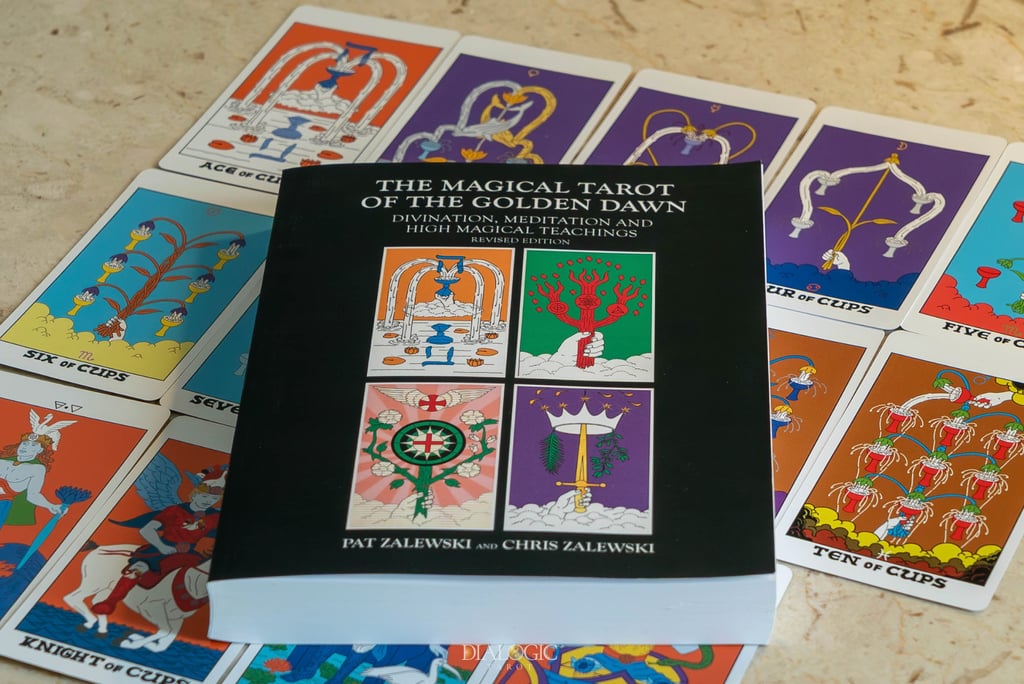
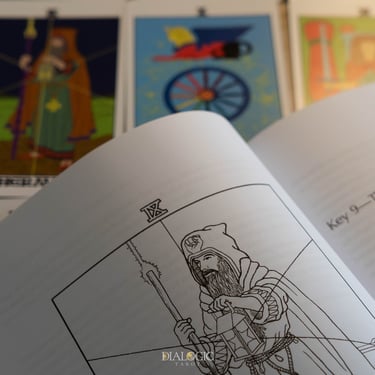
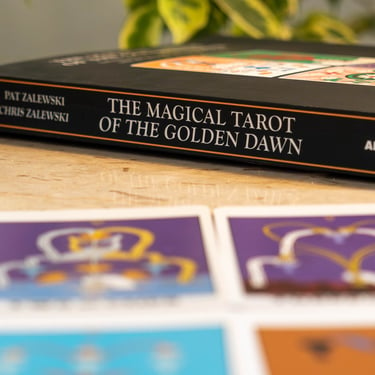
A review is always a conversation: with the object itself, with the tradition it inhabits, with the previous reviewers who have tried to place it. The Magical Tarot of the Golden Dawn — published by Aeon Books in 2022, illustrated by David Sledzinski, drawn from Pat and Chris Zalewski's long work with the Whare Ra material — invites that conversation almost programmatically. It is a deck that demands to be compared, because it positions itself explicitly against the existing Golden Dawn corpus.
So let us compare.
The lineage problem
There is no single "Golden Dawn deck." There are descents. Mathers and Westcott assembled Book T in the 1880s, drawing on the Tarot de Marseille structure but overlaying a Hermetic-Qabalistic apparatus. The Order itself revised the cards during its lifetime — particularly the court cards, and particularly under Felkin's Stella Matutina, which adjusted certain trumps after about 1903. Then in 1937–40 Israel Regardie published the Order's papers including Book T, and the modern reception began.
A review is always a conversation: with the object itself, with the tradition it inhabits, with the previous reviewers who have tried to place it. The Magical Tarot of the Golden Dawn — published by Aeon Books in 2022, illustrated by David Sledzinski, drawn from Pat and Chris Zalewski's long work with the Whare Ra material — invites that conversation almost programmatically. It is a deck that demands to be compared, because it positions itself explicitly against the existing Golden Dawn corpus.
So let us compare.
The lineage problem
There is no single "Golden Dawn deck." There are descents. Mathers and Westcott assembled Book T in the 1880s, drawing on the Tarot de Marseille structure but overlaying a Hermetic-Qabalistic apparatus. The Order itself revised the cards during its lifetime — particularly the court cards, and particularly under Felkin's Stella Matutina, which adjusted certain trumps after about 1903. Then in 1937–40 Israel Regardie published the Order's papers including Book T, and the modern reception began.
What followed in print:
Paul Foster Case's BOTA (1931), distinct enough to be its own school
Robert Wang's Golden Dawn Tarot (1977/78), the first commercial deck, supervised by Regardie, built from color photocopies of Regardie's stolen originals
Godfrey Dowson's Hermetic Tarot (1980), black-and-white, virtuosic, deeply Thoth-influenced
The Ciceros' Golden Dawn Magical Tarot (1991), the HOGD, Inc. lineage standard, the first commercial deck to apply the four color scales
Lon Milo and Constance DuQuette's Tarot of Ceremonial Magick (1997), idiosyncratic and ritual-focused
And now the Zalewski / Sledzinski Magical Tarot of the Golden Dawn (Aeon, 2022)
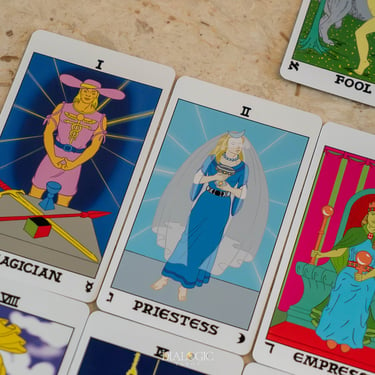
Each of these decks makes implicit claims about which Golden Dawn it represents. The Zalewskis' claim, made explicit in the 2019 book, is that they have gone back to the Whare Ra material — received from Jack Taylor, with the Zalewskis' first Havelock North visit dated to 1980 — before the Stella Matutina revisions complicated the line. Their Magician, for instance, retains the Four Talismans of Ireland on the altar, not the elemental weapons; Wang inherited the Felkin-era substitution. Their court cards work from the Wynn Westcott sketches (with the honest acknowledgement, in the book, that the attribution to Westcott himself is not certain).
This is a philological claim, and it is testable.
A brief structural preliminary: the Tree of Life
Before any discussion of the color scales can proceed, the structure they color requires a sketch. The Tree of Life is the Qabalistic diagram on which the entire Golden Dawn tarot architecture rests — and not as ornament, but as the foundational schema from which every card derives its identity.
The ten emanations of the Tree, the sephiroth (singular sephirah), are: Kether (Crown, pure being, "I am"), Chokmah (Wisdom, the active masculine principle), Binah (Understanding, the receptive feminine), Chesed (Mercy, expansion, benevolence), Geburah (Severity, contraction, justice), Tiphareth (Beauty, the harmonizing sun at the heart of the diagram), Netzach (Victory, desire and emotion), Hod (Splendor, intellect and language), Yesod (Foundation, the astral and the subconscious), and Malkuth (the Kingdom, manifest matter and the body).
These arrange themselves in three vertical columns or pillars — the right Pillar of Mercy (Chokmah, Chesed, Netzach), the left Pillar of Severity (Binah, Geburah, Hod), and the central Pillar of Equilibrium (Kether, Tiphareth, Yesod, Malkuth). Between them run twenty-two connecting paths, one for each letter of the Hebrew alphabet, and — by the Golden Dawn's attribution — one for each trump of the Tarot. The whole Tree is then understood to exist at four levels of manifestation simultaneously, the Four Worlds (Atziluth the archetypal, Briah the creative, Yetzirah the formative, Assiah the material), corresponding to the four letters of the divine name YHVH and to the four suits of the minor arcana.
The operative consequence: the entire structure of the tarot — 22 trumps plus four suits of fourteen — maps directly onto the Tree. The trumps are the twenty-two paths. The pip Aces through Tens are the ten sephiroth, suit by suit, each suit anchored to one of the Four Worlds. The sixteen court cards encode the inner four-letter structure of those worlds. The Golden Dawn tarot is, at its foundation, the Tree of Life dealt out as 78 cards. This is what a deck like the Magical Tarot is attempting to render visible — not pictures, but a working diagram of the Tree.
What the deck actually does
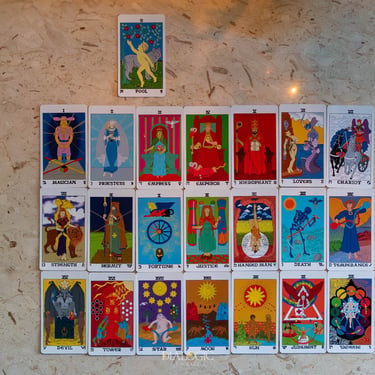
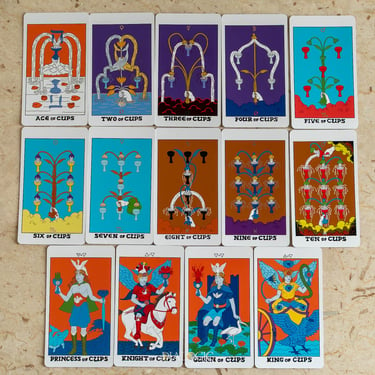
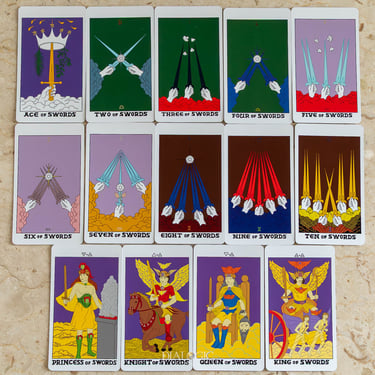
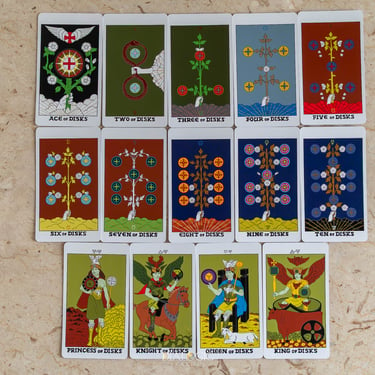
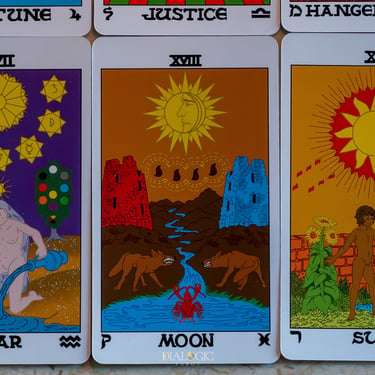
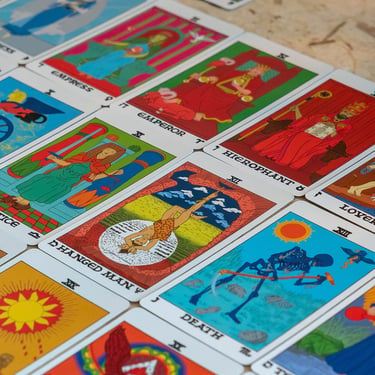
The most consequential design choice is invisible to a casual eye and unmistakable to a Golden Dawn student: the consistent application of all four color scales — King (Atziluth/Fire), Queen (Briah/Water), Prince (Yetzirah/Air), Princess (Assiah/Earth) — across the entire deck.
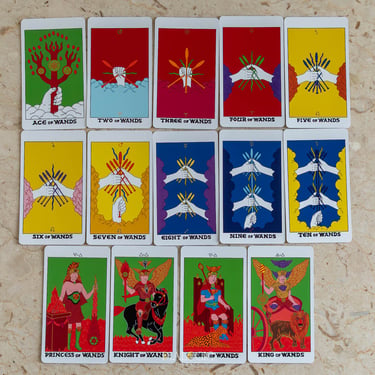
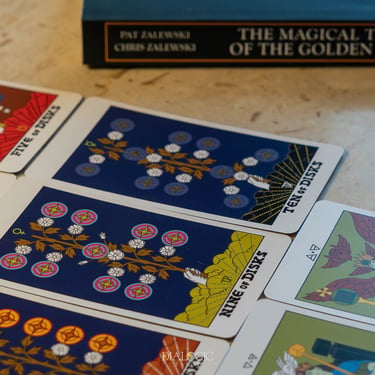
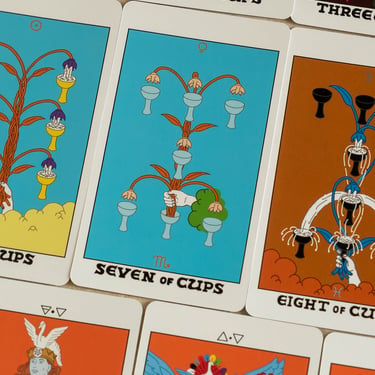
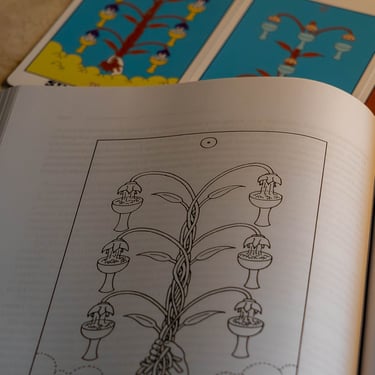
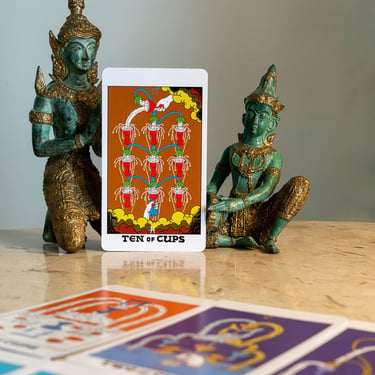
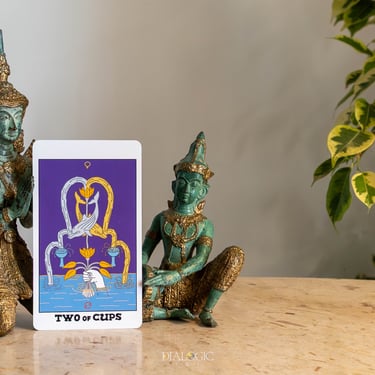
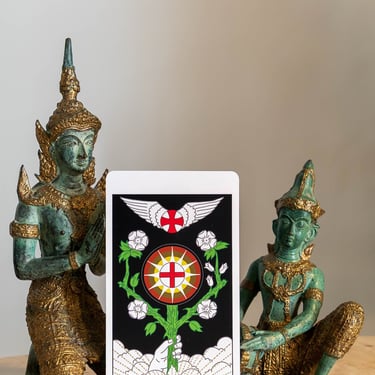
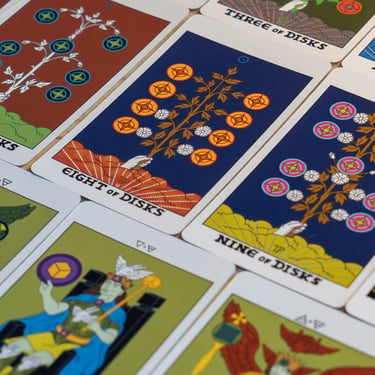
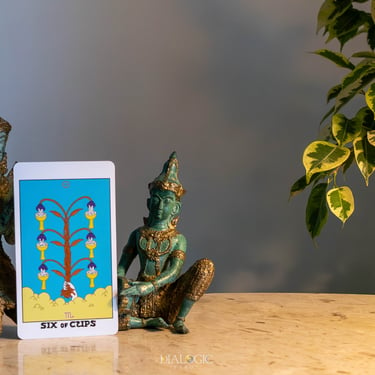
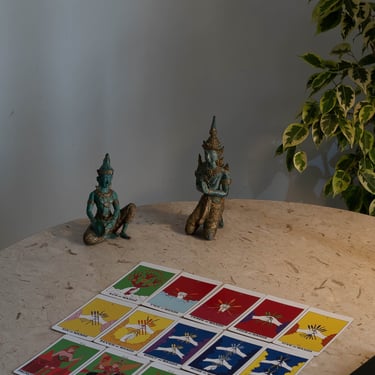
This is precisely what the Wang deck does not do. The pips of the Wang deck do not key consistently to the color scales; the Magical Tarot pips do. As Benebell Wen observed in her detailed comparative review, the Aces emphasize the white of Kether; the Twos take Chokmah; the Threes Binah; the Fours Chesed; the pattern continues sephirothically through the Tens. Decanal astrological glyphs appear on the pip cards. The hands rendered in white throughout are color-symbolic, not flesh-toned. None of this is decorative. All of it is doctrinal.
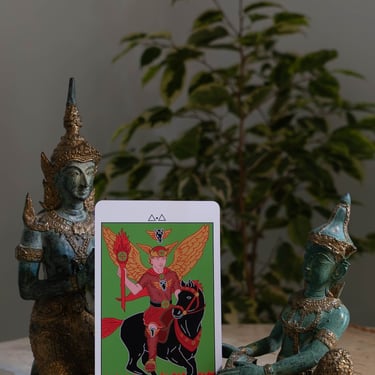
For the courts, Wen's analysis of the King of Cups (primary yellow and primary blue, with complementary purple and orange) and Knight of Disks (red and green, holding a citrine-olive-russet disk because he is Yod in Malkuth) demonstrates how the scales operate combinatorially — each court card is the elemental letter of YHVH situated within another element, and the color encodes that situation.
In dialogue with the Wang deck this is a corrective; in dialogue with the Cicero deck it is a different reading of the same source material (the Ciceros apply the four scales but in the HOGD, Inc. interpretation, with specific assignments differing from the Whare Ra reading); in dialogue with Dowson's Hermetic it is the chromatic answer to that deck's monochrome elegance.
Color as vibration: the doctrinal underpinning
The Order's commitment to color rests on a metaphysical claim that deserves taking seriously even where one does not share its premises. The Golden Dawn was founded in 1888, in a decade when physics was discovering invisible vibratory worlds at an unprecedented rate — electromagnetism had been mathematized by Maxwell, X-rays would arrive in 1895, radioactivity in 1896, and the educated public imagination was alive to the idea that reality consisted of fields and frequencies most of which the eye could not see. Late-Victorian esotericism — Theosophy, Mesmerism, the Golden Dawn, the broader spiritualist current — pushed the analogy one step further: if these invisible vibrations were real and quantifiable, why should the astral, etheric, or akashic ones not be?
Color, in this framework, is not a stimulus the eye decodes but a vibratory signature on a continuous spectrum that also includes sound, thought, emotion, and spiritual state. The Order's whole apparatus of correspondences — color, sound, scent, plant, metal, deity, Hebrew letter — assumes these are different octaves of the same underlying tone, so that striking one note sounds the entire chord.
The codification of the four color scales into the form the Order then taught falls largely to Florence Farr — admitted to the Inner Order in 1891, Praemonstratrix from 1894, founder of the inner Sphere Group, and a trained artist alongside Moina Mathers. Farr's notes preserve an early version of the scales that Crowley's Liber 777 (1909) and Regardie's published collections would later slightly revise into the standardized tables most modern practitioners now know. The Whare Ra deck the Zalewskis received sits in this same lineage of continuous revision: not the Farr version verbatim, not the Crowley/Regardie version verbatim, but the Stella Matutina/Whare Ra reading specifically.
When the practitioner sits with the Magical Tarot's Empress robed in radical greens and whites, the doctrinal claim is that they are not appreciating an image. They are vibrating, briefly, in a specific key — one that Farr and her contemporaries laid out a hundred and thirty years ago, that the Whare Ra adepts then transmitted, and that Sledzinski has now rendered for print. Whether this claim is literally true, metaphorically useful, or operationally productive is the question every Golden Dawn practitioner ends up sitting with for years.
The scales in practice
A review that gestures at the color scales without showing what they are is incomplete. The practical minimum is as follows.
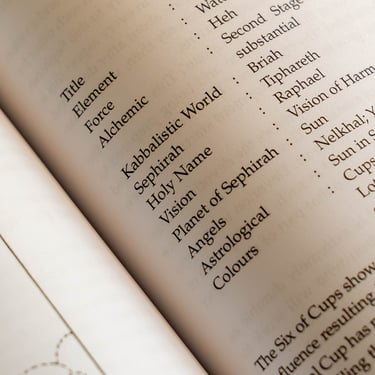
Each of the four scales assigns a color to each of the ten sephiroth on the Tree of Life. The King Scale, considered the most archetypally pure form, runs roughly: Kether a brilliance approaching white; Chokmah a soft blue; Binah crimson; Chesed deep violet; Geburah orange; Tiphareth a clear rose-pink; Netzach amber; Hod violet-purple; Yesod indigo; Malkuth yellow. The Queen Scale shifts these into something more receptive and material — Binah becomes black, Tiphareth a clear gold-yellow, Netzach an emerald. The Prince Scale modulates again into more intellectual, slightly murky tones — Chesed deep purple, Netzach a bright yellow-green. The Princess Scale, the densest and most physical, takes most of the colors and adds flecks or rays of a complementary hue — Malkuth becomes black rayed with yellow, with citrine, olive, and russet for the three other quarters of the sphere.
The four scales exist because the same sephira manifests at four different levels in Qabalistic theory, one for each of the Four Worlds, and the four scales encode what each sephira looks like at each level. Same idea, four wavelengths.
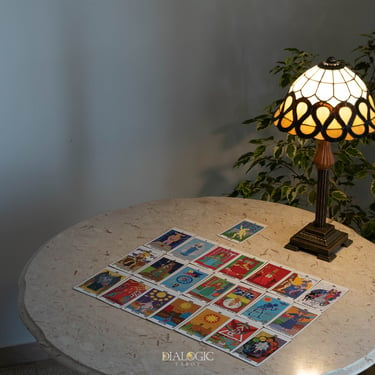
For practical application: in the standard Golden Dawn mapping, the four suits correspond to the four worlds — Wands to Atziluth/Fire, Cups to Briah/Water, Swords to Yetzirah/Air, Disks to Assiah/Earth — and the pip number corresponds to the sephira. Lay the four Threes from the Magical Tarot side by side and what should be visible is the same sephirothic position, Binah, expressed in four different keys: crimson, black, dark brown, and a grey flecked with pink. Same chord, four octaves. The complementary "flashing" hue is then added to produce optical vibration. The trumps work on the 22 paths between sephiroth rather than the sephiroth themselves, each Hebrew letter carrying its own four-scale color set. The courts combine the rank's elemental letter with the suit's — Wen's observation that the King of Cups appears in primary yellow and primary blue is precisely Air-of-Water made visible.
The deck does not teach this. The book does, in considerable detail. The relationship between deck and book is precisely that of working diagram and reference manual.
Where Sledzinski stands
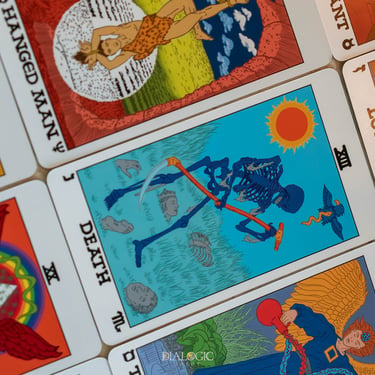
The art question is harder to argue about, because it is partly taste. Sledzinski's medium reads as digital with a deliberate retro surface — Wen describes it as "high-concept slightly surreal modern-mythic," and that fits. Saturation is bolder than Wang's pencil-rendered original; texture is flatter than a painted deck would be. To some this will read as crisp and graphic; to others as missing the analog warmth a Whare Ra-derived deck might be expected to carry.
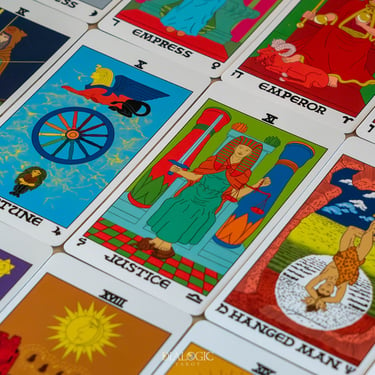
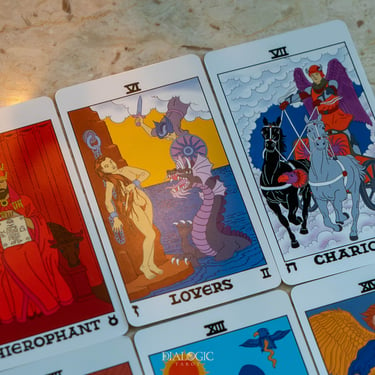
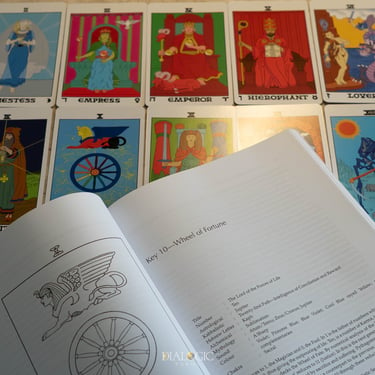
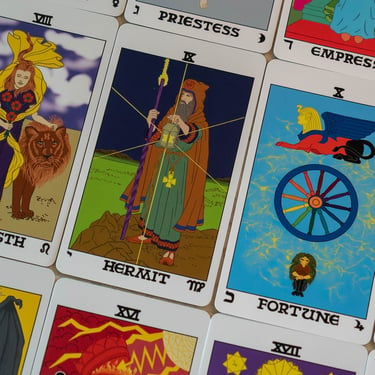
The iconographic decisions, however, are mostly text-faithful. The Fool stands in the form of Aleph, with the six roses of Lepus and the Tree. The Lovers retains the Perseus-Andromeda-Dragon schema with sword, helm, and shield. Strength carries the alchemical Green and Red Lion symbolism — the maiden robed in violet with a yellow lemniscate sash, the tamed beast as the Red Lion. The Wheel of Fortune has its twelve spokes in instructed color sequence; the inscription of Ashtaroth around the rim is left for the practitioner to add, as Book T permits. The Queen of Swords carries the Thoth-style severed head and the crown of winged child's head. Judgment's seven prismatic rainbow corresponds to Liber 777; the Universe carries the twelve zodiacal discs and the seventy-two ShemHamphoresh angels.
These are not arbitrary. Each is recoverable from a specific Golden Dawn lecture.
The companion book as scholarly artifact
The 2019 revised Magical Tarot of the Golden Dawn: Divination, Meditation and High Magical Teachings should be evaluated separately from the deck and partially against the existing literature.
Where it surpasses its peers:
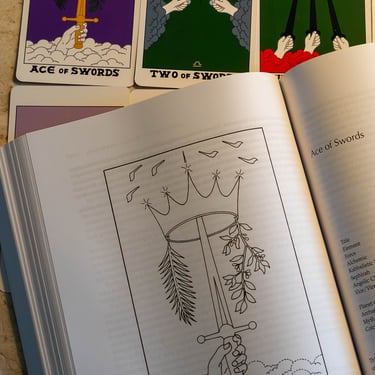
The card-by-card treatment is the most exhaustive in print. For each card you get the sephirothic situation (where applicable), the decanal ruler with planet-in-sign analysis, the alchemical operation, geomancy, gematria, color scale prescriptions, and a synthesized divinatory meaning; the Court Card sections widen further to include I Ching and Tattva correspondences. As one anonymous commenter on Wen's review noted, Cicero, Wang, and even DuQuette's Thoth volumes are conspicuously thin on divinatory application — Zalewski's book finally treats it as something deserving the same rigor as the magical theory.
The systematic alchemical mapping across all 78 cards is, as far as I am aware, the first in print. The expansion of the Book of General Correspondences tabulations into running commentary is also genuinely useful.
Where it falls short:
The structural apparatus is poor for a reference work. No index. No bibliography. No footnotes. The TABI reviewer raised this and they are correct — for a 506-page encyclopedia one reaches for repeatedly, a way in is necessary. The prose is dense and presumes a reader already conversant with the Kabbalah and the Hermetic correspondence system; this is not a flaw on its own terms, but it does narrow the audience.
There are minor editorial inconsistencies — the Horoscope spread, for instance, shows different placements between diagram and commentary, and one is forced to defer to the prose.
A note for readers outside the Golden Dawn tradition
The review so far has assumed a reader either inside the Golden Dawn lineage or actively curious about entering it. A wider point deserves making.
The Rider-Waite-Smith deck, and the entire English-language tarot market that descends from it, was made by Golden Dawn members. Arthur Edward Waite was an initiated adept of the Order; Pamela Colman Smith was a member at Isis-Urania Temple. The imagery, keywords, planetary and elemental attributions, decanal logic, and even the count and ordering of the cards that have been transmitted through a century of popular guidebooks all derive from this small late-Victorian London lodge and the documents it produced. Reading with an RWS deck or any of its many contemporary derivatives means reading inside the Golden Dawn system, whether the reader acknowledges the inheritance or not.
This does not require the casual or intuitive reader to take up Qabalistic study. It does mean that engagement with a deck like the Magical Tarot — and a book like the Zalewski volume — has value beyond the specifically initiatory. Sooner or later most serious readers want to know what is structurally underneath the imagery they have absorbed: why the elements are arranged the way they are, why the Lovers card looks like it looks, why Strength is the eighth trump and Justice the eleventh. The Zalewski volume answers these questions with as much rigor as exists in print.
Who is the deck talking to?
This is, fundamentally, the question every Golden Dawn deck has to answer. The Wang deck speaks to the historical reception of the system through Regardie. The Cicero deck speaks to a contemporary HOGD practice that wants beauty and ritual usability together. Dowson's Hermetic speaks to the Thoth-adjacent reader who wants precision over warmth. The DuQuette deck speaks to ritual practitioners.
The Magical Tarot speaks to the Whare Ra lineage specifically, and to the reader who wants to see the color scales operating doctrinally across the entire deck. It is the most technically rigorous of the color-scale interpretations available in the Whare Ra reading; it is also, partly because of that, the least casually beautiful. It will not seduce a reader into the Golden Dawn system; it will reward a reader already inside it.
In the broader conversation, this deck is something the field has needed: a public, fully colored implementation of the Whare Ra material with a serious scholarly apparatus behind it. The flaws — the missing index, the dense prose, the modest tuck box — are real and worth naming. The contribution outweighs them.
A final note on study, practice, and the dialogic approach
This review has surveyed a considerable body of information — color scales, sephiroth, four worlds, Hebrew letters, planetary and elemental attributions, alchemical operations, lineages running from Mathers and Farr through Whare Ra to Sledzinski's brush. The emphasis throughout has been on structure and lineage because the deck and book under discussion are themselves structural and lineage-bound: a working diagram and its reference manual.
But that is only half of what tarot is, and on a site called Dialogic Tarot the other half deserves naming. The cards must be lived and experienced as much as they are studied. Books like the Zalewskis' are guidance — they tell the reader what the system means, what the colors do, what doctrine sits behind the image — but the kind of knowledge that actually changes how one reads and how one moves through the world does not arrive through books. It arrives from within. From sitting with a single card long enough that its energies begin to speak in their own register. From meditating on the symbols until they are no longer symbols but conditions of being. From contemplating, returning, putting the question to the card one more time and listening for what is different. Study is the map. The territory is the practitioner's interior.
This is the principle that has shaped Dialogic Tarot as a school of practice rather than a school of doctrine. The Zalewski deck and book provide structural understanding better than almost anything else currently in print, and they are recommended without hesitation for any reader serious about engaging with the Golden Dawn system. What this school attempts to offer alongside that structure is the experiential pathway — the disciplined contemplation, the dialogue between the reader and the cards in which understanding is generated rather than received. Both halves matter. Without the structure, intuition drifts. Without the experience, structure is a dead diagram. Held together, the deck stops being an object on a desk and becomes, very slowly, a way of seeing.
Bibliographic details:
The Magical Tarot of the Golden Dawn Deck. Pat Zalewski & David Sledzinski. Aeon Books, 2022. 78 cards + booklet. ISBN 9781913504151.
The Magical Tarot of the Golden Dawn: Divination, Meditation and High Magical Teachings — Revised Edition. Pat Zalewski & Chris Zalewski. Aeon Books, January 2019. 506 pp. ISBN 9781911597292.
Reviewed alongside (for comparative reference):
Wang, Robert. Golden Dawn Tarot. U.S. Games, 1977/78.
Cicero, Chic & Sandra Tabatha. Golden Dawn Magical Tarot. Llewellyn, 1991.
Dowson, Godfrey. The Hermetic Tarot. U.S. Games, 1980.
Regardie, Israel. The Golden Dawn. Llewellyn, 1937–40 / 1989.
Related review consulted:
Benebell Wen, "The Magical Tarot of the Golden Dawn by Pat Zalewski and David Sledzinski," benebellwen.com, 20 November 2022.
What followed in print:
Paul Foster Case's BOTA (1931), distinct enough to be its own school
Robert Wang's Golden Dawn Tarot (1977/78), the first commercial deck, supervised by Regardie, built from color photocopies of Regardie's stolen originals
Godfrey Dowson's Hermetic Tarot (1980), black-and-white, virtuosic, deeply Thoth-influenced
The Ciceros' Golden Dawn Magical Tarot (1991), the HOGD, Inc. lineage standard, the first commercial deck to apply the four color scales
Lon Milo and Constance DuQuette's Tarot of Ceremonial Magick (1997), idiosyncratic and ritual-focused
And now the Zalewski / Sledzinski Magical Tarot of the Golden Dawn (Aeon, 2022)
Each of these decks makes implicit claims about which Golden Dawn it represents. The Zalewskis' claim, made explicit in the 2019 book, is that they have gone back to the Whare Ra material — received from Jack Taylor, with the Zalewskis' first Havelock North visit dated to 1980 — before the Stella Matutina revisions complicated the line. Their Magician, for instance, retains the Four Talismans of Ireland on the altar, not the elemental weapons; Wang inherited the Felkin-era substitution. Their court cards work from the Wynn Westcott sketches (with the honest acknowledgement, in the book, that the attribution to Westcott himself is not certain).
This is a philological claim, and it is testable.
A brief structural preliminary: the Tree of Life
Before any discussion of the color scales can proceed, the structure they color requires a sketch. The Tree of Life is the Qabalistic diagram on which the entire Golden Dawn tarot architecture rests — and not as ornament, but as the foundational schema from which every card derives its identity.
The ten emanations of the Tree, the sephiroth (singular sephirah), are: Kether (Crown, pure being, "I am"), Chokmah (Wisdom, the active masculine principle), Binah (Understanding, the receptive feminine), Chesed (Mercy, expansion, benevolence), Geburah (Severity, contraction, justice), Tiphareth (Beauty, the harmonizing sun at the heart of the diagram), Netzach (Victory, desire and emotion), Hod (Splendor, intellect and language), Yesod (Foundation, the astral and the subconscious), and Malkuth (the Kingdom, manifest matter and the body).
These arrange themselves in three vertical columns or pillars — the right Pillar of Mercy (Chokmah, Chesed, Netzach), the left Pillar of Severity (Binah, Geburah, Hod), and the central Pillar of Equilibrium (Kether, Tiphareth, Yesod, Malkuth). Between them run twenty-two connecting paths, one for each letter of the Hebrew alphabet, and — by the Golden Dawn's attribution — one for each trump of the Tarot. The whole Tree is then understood to exist at four levels of manifestation simultaneously, the Four Worlds (Atziluth the archetypal, Briah the creative, Yetzirah the formative, Assiah the material), corresponding to the four letters of the divine name YHVH and to the four suits of the minor arcana.
The operative consequence: the entire structure of the tarot — 22 trumps plus four suits of fourteen — maps directly onto the Tree. The trumps are the twenty-two paths. The pip Aces through Tens are the ten sephiroth, suit by suit, each suit anchored to one of the Four Worlds. The sixteen court cards encode the inner four-letter structure of those worlds. The Golden Dawn tarot is, at its foundation, the Tree of Life dealt out as 78 cards. This is what a deck like the Magical Tarot is attempting to render visible — not pictures, but a working diagram of the Tree.
What the deck actually does
The most consequential design choice is invisible to a casual eye and unmistakable to a Golden Dawn student: the consistent application of all four color scales — King (Atziluth/Fire), Queen (Briah/Water), Prince (Yetzirah/Air), Princess (Assiah/Earth) — across the entire deck.
This is precisely what the Wang deck does not do. The pips of the Wang deck do not key consistently to the color scales; the Magical Tarot pips do. The Aces emphasize the white of Kether; the Twos take Chokmah; the Threes Binah; the Fours Chesed; the pattern continues sephirothically through the Tens. Decanal astrological glyphs appear on the pip cards. The hands rendered in white throughout are color-symbolic, not flesh-toned. None of this is decorative. All of it is doctrinal.
For the courts, Wen's analysis of the King of Cups (primary yellow and primary blue, with complementary purple and orange) and Knight of Disks (red and green, holding a citrine-olive-russet disk because he is Yod in Malkuth) demonstrates how the scales operate combinatorially — each court card is the elemental letter of YHVH situated within another element, and the color encodes that situation.
In dialogue with the Wang deck this is a corrective; in dialogue with the Cicero deck it is a different reading of the same source material (the Ciceros apply the four scales but in the HOGD, Inc. interpretation, with specific assignments differing from the Whare Ra reading); in dialogue with Dowson's Hermetic it is the chromatic answer to that deck's monochrome elegance.
Color as vibration: the doctrinal underpinning
The Order's commitment to color rests on a metaphysical claim that deserves taking seriously even where one does not share its premises. The Golden Dawn was founded in 1888, in a decade when physics was discovering invisible vibratory worlds at an unprecedented rate — electromagnetism had been mathematized by Maxwell, X-rays would arrive in 1895, radioactivity in 1896, and the educated public imagination was alive to the idea that reality consisted of fields and frequencies most of which the eye could not see. Late-Victorian esotericism — Theosophy, Mesmerism, the Golden Dawn, the broader spiritualist current — pushed the analogy one step further: if these invisible vibrations were real and quantifiable, why should the astral, etheric, or akashic ones not be?
Color, in this framework, is not a stimulus the eye decodes but a vibratory signature on a continuous spectrum that also includes sound, thought, emotion, and spiritual state. The Order's whole apparatus of correspondences — color, sound, scent, plant, metal, deity, Hebrew letter — assumes these are different octaves of the same underlying tone, so that striking one note sounds the entire chord.
The codification of the four color scales into the form the Order then taught falls largely to Florence Farr — admitted to the Inner Order in 1891, Praemonstratrix from 1894, founder of the inner Sphere Group, and a trained artist alongside Moina Mathers. Farr's notes preserve an early version of the scales that Crowley's Liber 777 (1909) and Regardie's published collections would later slightly revise into the standardized tables most modern practitioners now know. The Whare Ra deck the Zalewskis received sits in this same lineage of continuous revision: not the Farr version verbatim, not the Crowley/Regardie version verbatim, but the Stella Matutina/Whare Ra reading specifically.
When the practitioner sits with the Magical Tarot's Empress robed in radical greens and whites, the doctrinal claim is that they are not appreciating an image. They are vibrating, briefly, in a specific key — one that Farr and her contemporaries laid out a hundred and thirty years ago, that the Whare Ra adepts then transmitted, and that Sledzinski has now rendered for print. Whether this claim is literally true, metaphorically useful, or operationally productive is the question every Golden Dawn practitioner ends up sitting with for years.
The scales in practice
A review that gestures at the color scales without showing what they are is incomplete. The practical minimum is as follows.
Each of the four scales assigns a color to each of the ten sephiroth on the Tree of Life. The King Scale, considered the most archetypally pure form, runs roughly: Kether a brilliance approaching white; Chokmah a soft blue; Binah crimson; Chesed deep violet; Geburah orange; Tiphareth a clear rose-pink; Netzach amber; Hod violet-purple; Yesod indigo; Malkuth yellow. The Queen Scale shifts these into something more receptive and material — Binah becomes black, Tiphareth a clear gold-yellow, Netzach an emerald. The Prince Scale modulates again into more intellectual, slightly murky tones — Chesed deep purple, Netzach a bright yellow-green. The Princess Scale, the densest and most physical, takes most of the colors and adds flecks or rays of a complementary hue — Malkuth becomes black rayed with yellow, with citrine, olive, and russet for the three other quarters of the sphere.
The four scales exist because the same sephira manifests at four different levels in Qabalistic theory, one for each of the Four Worlds, and the four scales encode what each sephira looks like at each level. Same idea, four wavelengths.
For practical application: in the standard Golden Dawn mapping, the four suits correspond to the four worlds — Wands to Atziluth/Fire, Cups to Briah/Water, Swords to Yetzirah/Air, Disks to Assiah/Earth — and the pip number corresponds to the sephira. Lay the four Threes from the Magical Tarot side by side and what should be visible is the same sephirothic position, Binah, expressed in four different keys: crimson, black, dark brown, and a grey flecked with pink. Same chord, four octaves. The complementary "flashing" hue is then added to produce optical vibration. The trumps work on the 22 paths between sephiroth rather than the sephiroth themselves, each Hebrew letter carrying its own four-scale color set. The courts combine the rank's elemental letter with the suit's — Wen's observation that the King of Cups appears in primary yellow and primary blue is precisely Air-of-Water made visible.
The deck does not teach this. The book does, in considerable detail. The relationship between deck and book is precisely that of working diagram and reference manual.
Where Sledzinski stands
The art question is harder to argue about, because it is partly taste. Sledzinski's medium reads as digital with a deliberate retro surface — Wen describes it as "high-concept slightly surreal modern-mythic," and that fits. Saturation is bolder than Wang's pencil-rendered original; texture is flatter than a painted deck would be. To some this will read as crisp and graphic; to others as missing the analog warmth a Whare Ra-derived deck might be expected to carry.
The iconographic decisions, however, are mostly text-faithful. The Fool stands in the form of Aleph, with the six roses of Lepus and the Tree. The Lovers retains the Perseus-Andromeda-Dragon schema with sword, helm, and shield. Strength carries the alchemical Green and Red Lion symbolism — the maiden robed in violet with a yellow lemniscate sash, the tamed beast as the Red Lion. The Wheel of Fortune has its twelve spokes in instructed color sequence; the inscription of Ashtaroth around the rim is left for the practitioner to add, as Book T permits. The Queen of Swords carries the Thoth-style severed head and the crown of winged child's head. Judgment's seven prismatic rainbow corresponds to Liber 777; the Universe carries the twelve zodiacal discs and the seventy-two ShemHamphoresh angels.
These are not arbitrary. Each is recoverable from a specific Golden Dawn lecture.
The companion book as scholarly artifact
The 2019 revised Magical Tarot of the Golden Dawn: Divination, Meditation and High Magical Teachings should be evaluated separately from the deck and partially against the existing literature.
Where it surpasses its peers:
The card-by-card treatment is the most exhaustive in print. For each card you get the sephirothic situation (where applicable), the decanal ruler with planet-in-sign analysis, the alchemical operation, geomancy, gematria, color scale prescriptions, and a synthesized divinatory meaning; the Court Card sections widen further to include I Ching and Tattva correspondences. As one anonymous commenter on Wen's review noted, Cicero, Wang, and even DuQuette's Thoth volumes are conspicuously thin on divinatory application — Zalewski's book finally treats it as something deserving the same rigor as the magical theory.
The systematic alchemical mapping across all 78 cards is, as far as I am aware, the first in print. The expansion of the Book of General Correspondences tabulations into running commentary is also genuinely useful.
Where it falls short:
The structural apparatus is poor for a reference work. No index. No bibliography. No footnotes. The TABI reviewer raised this and they are correct — for a 506-page encyclopedia one reaches for repeatedly, a way in is necessary. The prose is dense and presumes a reader already conversant with the Kabbalah and the Hermetic correspondence system; this is not a flaw on its own terms, but it does narrow the audience.
There are minor editorial inconsistencies — the Horoscope spread, for instance, shows different placements between diagram and commentary, and one is forced to defer to the prose.
A note for readers outside the Golden Dawn tradition
The review so far has assumed a reader either inside the Golden Dawn lineage or actively curious about entering it. A wider point deserves making.
The Rider-Waite-Smith deck, and the entire English-language tarot market that descends from it, was made by Golden Dawn members. Arthur Edward Waite was an initiated adept of the Order; Pamela Colman Smith was a member at Isis-Urania Temple. The imagery, keywords, planetary and elemental attributions, decanal logic, and even the count and ordering of the cards that have been transmitted through a century of popular guidebooks all derive from this small late-Victorian London lodge and the documents it produced. Reading with an RWS deck or any of its many contemporary derivatives means reading inside the Golden Dawn system, whether the reader acknowledges the inheritance or not.
This does not require the casual or intuitive reader to take up Qabalistic study. It does mean that engagement with a deck like the Magical Tarot — and a book like the Zalewski volume — has value beyond the specifically initiatory. Sooner or later most serious readers want to know what is structurally underneath the imagery they have absorbed: why the elements are arranged the way they are, why the Lovers card looks like it looks, why Strength is the eighth trump and Justice the eleventh. The Zalewski volume answers these questions with as much rigor as exists in print.
Who is the deck talking to?
This is, fundamentally, the question every Golden Dawn deck has to answer. The Wang deck speaks to the historical reception of the system through Regardie. The Cicero deck speaks to a contemporary HOGD practice that wants beauty and ritual usability together. Dowson's Hermetic speaks to the Thoth-adjacent reader who wants precision over warmth. The DuQuette deck speaks to ritual practitioners.
The Magical Tarot speaks to the Whare Ra lineage specifically, and to the reader who wants to see the color scales operating doctrinally across the entire deck. It is the most technically rigorous of the color-scale interpretations available in the Whare Ra reading; it is also, partly because of that, the least casually beautiful. It will not seduce a reader into the Golden Dawn system; it will reward a reader already inside it.
In the broader conversation, this deck is something the field has needed: a public, fully colored implementation of the Whare Ra material with a serious scholarly apparatus behind it. The flaws — the missing index, the dense prose, the modest tuck box — are real and worth naming. The contribution outweighs them.
A final note on study, practice, and the dialogic approach
This review has surveyed a considerable body of information — color scales, sephiroth, four worlds, Hebrew letters, planetary and elemental attributions, alchemical operations, lineages running from Mathers and Farr through Whare Ra to Sledzinski's brush. The emphasis throughout has been on structure and lineage because the deck and book under discussion are themselves structural and lineage-bound: a working diagram and its reference manual.
But that is only half of what tarot is, and on a site called Dialogic Tarot the other half deserves naming. The cards must be lived and experienced as much as they are studied. Books like the Zalewskis' are guidance — they tell the reader what the system means, what the colors do, what doctrine sits behind the image — but the kind of knowledge that actually changes how one reads and how one moves through the world does not arrive through books. It arrives from within. From sitting with a single card long enough that its energies begin to speak in their own register. From meditating on the symbols until they are no longer symbols but conditions of being. From contemplating, returning, putting the question to the card one more time and listening for what is different. Study is the map. The territory is the practitioner's interior.
This is the principle that has shaped Dialogic Tarot as a school of practice rather than a school of doctrine. The Zalewski deck and book provide structural understanding better than almost anything else currently in print, and they are recommended without hesitation for any reader serious about engaging with the Golden Dawn system. What this school attempts to offer alongside that structure is the experiential pathway — the disciplined contemplation, the dialogue between the reader and the cards in which understanding is generated rather than received. Both halves matter. Without the structure, intuition drifts. Without the experience, structure is a dead diagram. Held together, the deck stops being an object on a desk and becomes, very slowly, a way of seeing.
Bibliographic details:
The Magical Tarot of the Golden Dawn Deck. Pat Zalewski & David Sledzinski. Aeon Books, 2022. 78 cards + booklet. ISBN 9781913504151.
The Magical Tarot of the Golden Dawn: Divination, Meditation and High Magical Teachings — Revised Edition. Pat Zalewski & Chris Zalewski. Aeon Books, January 2019. 506 pp. ISBN 9781911597292.
Reviewed alongside (for comparative reference):
Wang, Robert. Golden Dawn Tarot. U.S. Games, 1977/78.
Cicero, Chic & Sandra Tabatha. Golden Dawn Magical Tarot. Llewellyn, 1991.
Dowson, Godfrey. The Hermetic Tarot. U.S. Games, 1980.
Regardie, Israel. The Golden Dawn. Llewellyn, 1937–40 / 1989.
CONTACTS
ritarottelbac@dialogictarot.com
SUBSCRIBE TO OUR NEWSLETTER
Rita Rottelbac, phd
Tarot Reader · Visual Artist · Scholar
SITE
LEGAL
RESOURCES
Publications
Your contribution helps sustain the research,
writings, and creative explorations that keep
this project alive.
© 2026 Rita Rottelbac | All rights reserved.
All content is for educational and artistic purposes. Tarot readings are symbolic guidance, not legal or medical advice.
SUPPORT THE PROJECT