
The Green Mirror N°1. Lunar Semiotics in the Rider–Waite–Smith Tarot
Visibility, Ambiguity, and the Work of the Unconscious
ESSAYS
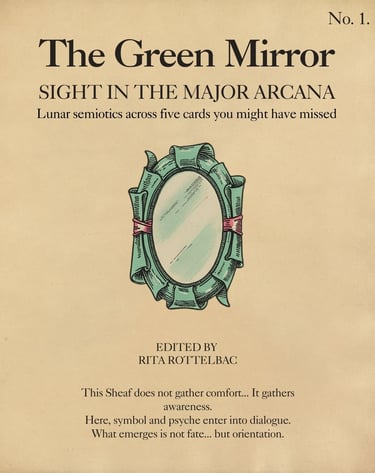
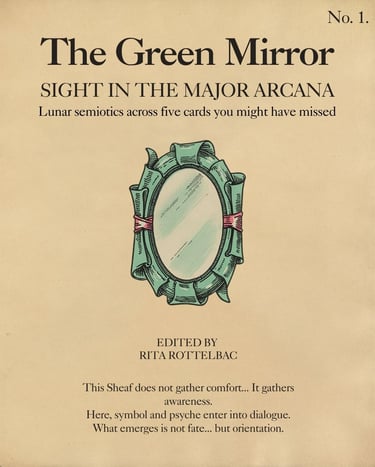
The Moon is most often discussed in tarot as a singular image: anxiety, illusion, the unconscious. Yet within the Rider–Waite–Smith Tarot, lunar imagery appears repeatedly and quietly across multiple cards, functioning less as a fixed symbol than as a structuring principle that influences how meaning is shaped.
This essay proposes an explorative claim: that the Moon in the RWS deck operates as a semiotic marker of cognition under conditions of partial visibility. Rather than simply announcing what is hidden, lunar imagery signals how knowledge emerges, recedes, and transforms within the psyche.
Attending to these recurring crescents allows us to read tarot not as a system of prediction, but as a visual theory of psychological process, archetypal wisdom and dialogic knowledge.
1. Two of Swords — Suspension as Cognitive Labor
In the Two of Swords, a waning crescent Moon hangs in the background—often overlooked, yet semantically central.
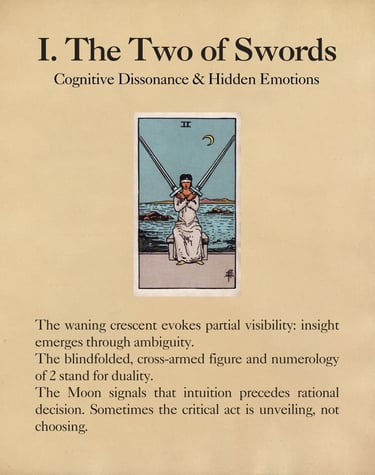
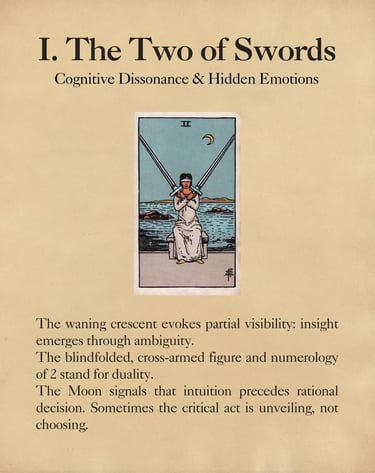
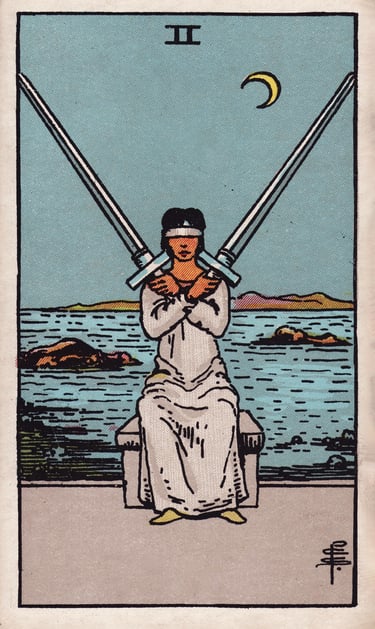
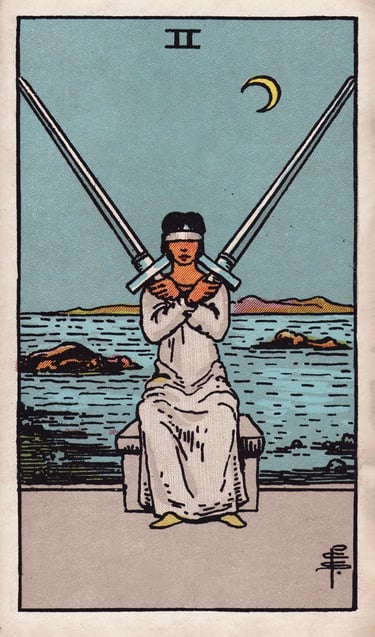
The card’s visual grammar emphasizes refusal: crossed arms, blindfold, balanced swords. Numerologically, two introduces polarity and tension rather than resolution. The Moon complicates this further. Its partial illumination suggests epistemic incompleteness—a moment in which intuitive material has surfaced but has not yet been integrated into conscious judgment.
From this perspective, the card depicts a psychologically necessary pause. Decision is deferred not out of avoidance, but because cognition is still unfolding beneath awareness. The Moon marks this interval as meaningful rather than deficient.
The image suggests that not choosing can itself be a form of ethical attention. The claim is not that indecision is inherently virtuous. Rather, the image suggests that there are circumstances in which premature resolution would do violence to the psychic situation at hand.
The blindfolded figure does not refuse responsibility; she temporarily suspends judgment in order to hold competing values, affects, or truths without collapsing them into a false synthesis. In ethical terms, this resembles what moral philosophers have described as attentiveness: a willingness to remain present to complexity rather than resolving tension for the sake of comfort, certainty, or control.
The waning crescent Moon reinforces this reading by indicating partial visibility. Not all relevant information—internal or external—is yet available to consciousness. Under such conditions, decisive action may serve the ego’s desire for closure rather than the situation’s demand for care. The card therefore frames hesitation not as avoidance, but as a disciplined waiting, in which responsibility is expressed through restraint. Ethics here is not located in outcome, but in how one relates to uncertainty.
2. Eight of Cups — Departure as Reorientation
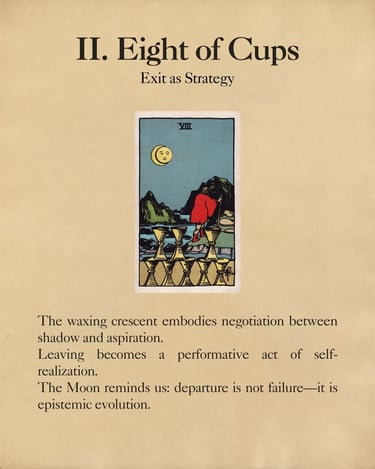
The Eight of Cups features a waxing crescent Moon, signaling movement toward—but not yet into—full illumination.
Here, departure is framed neither as loss nor failure, but as a response to internal reconfiguration. The cups remain upright; nothing is visibly broken. The Moon’s phase implies aspiration emerging from dissatisfaction that has not yet found language.
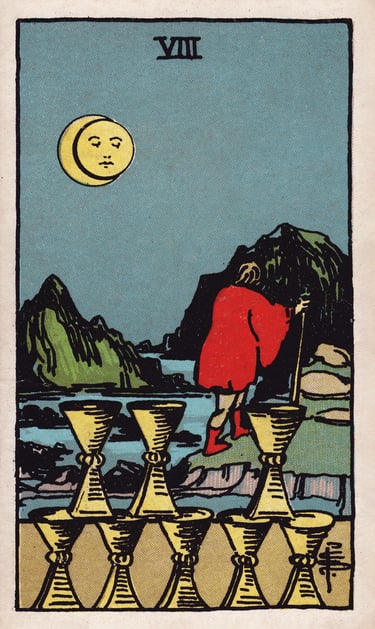
Psychologically, the card aligns with moments in which the ego recognizes that previous sources of meaning no longer suffice. The Moon functions as a transitional signifier: the path forward is dim, but the impulse to leave is already intelligible at an intuitive level.
The image reframes leaving as a mode of knowing and an attachment to security and what is familiar, rather than a negation of prior success.
3. The Moon (XVIII) — Symbol Before Interpretation
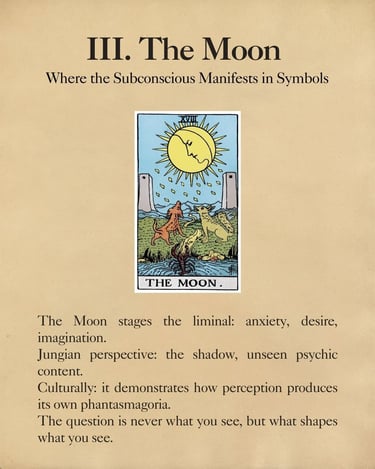
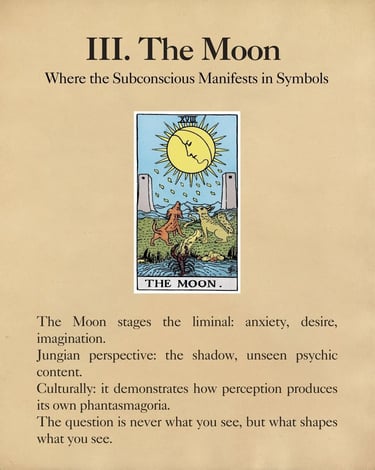
When lunar imagery becomes central in The Moon, the deck presents the psyche without interpretive mediation.
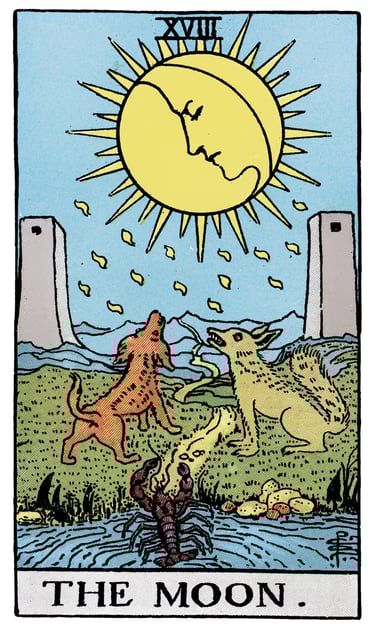
The scene is disorienting: animals howl, a crustacean emerges from water, a path dissolves into uncertainty. The Moon does not clarify the scene; it intensifies ambiguity. From a depth-psychological perspective, this card corresponds to moments when unconscious material becomes active but remains symbolically encoded.
Drawing on the work of Carl Jung, the card can be read as an encounter with autonomous psychic content—images that precede rational explanation and resist immediate integration.
The Moon here does not deceive so much as reveal the conditions under which perception constructs meaning. What appears is shaped as much by internal structures as by external reality.
4. The Chariot (VII) — Intuition Within Mastery
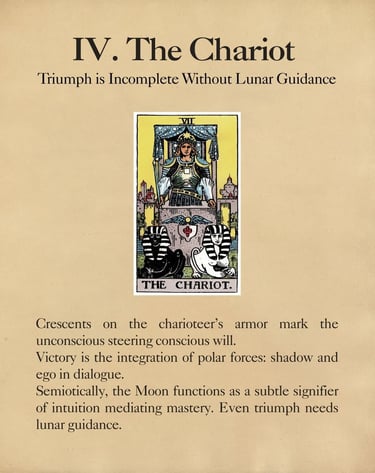
The Chariot is typically associated with will, discipline, and conscious direction. Yet the presence of crescent moons on the charioteer’s armor complicates this reading.
These crescents suggest that effective mastery depends not on the suppression of unconscious forces, but on their incorporation. The sphinxes—polarized, unmoving—are not controlled through force, but through symbolic alignment.
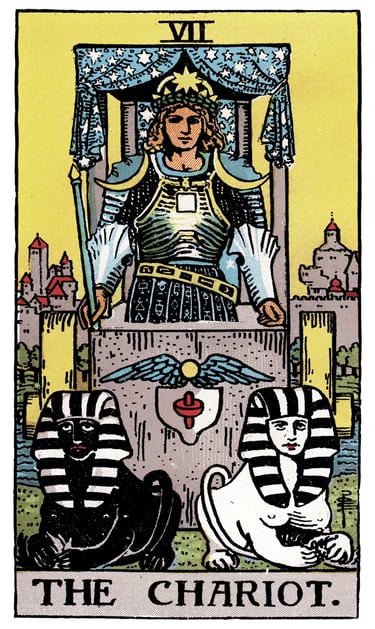
Within esoteric and Hermetic frameworks, the Moon frequently mediates between opposites. In this card, it quietly signals that conscious intention alone is insufficient. Movement requires dialogue between ego and unconscious orientation.
Victory, in this sense, is a relational process rather than a unilateral achievement.
5. The High Priestess (II) — Knowledge That Withholds
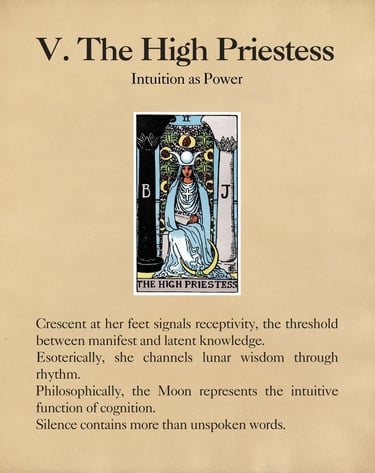
At the feet of the High Priestess rests a crescent Moon, anchoring her association with lunar modes of knowing.
She does not speak; she does not instruct. Instead, she marks the boundary between what can be articulated and what must remain latent. Esoterically, she is often associated with rhythm, receptivity, and cyclical time. Epistemologically, she represents cognition that is non-discursive and pre-verbal.
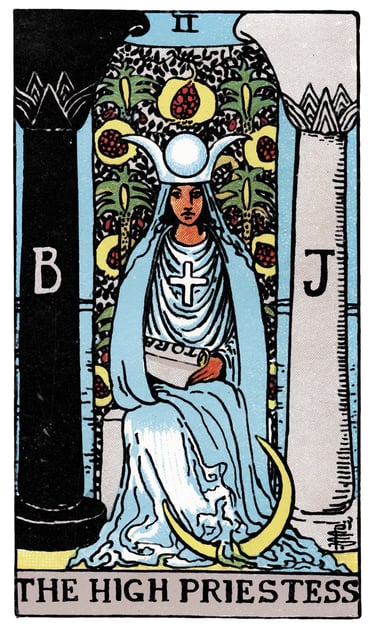
The Moon here signals a form of knowledge that is not yet—or not ever—meant to be translated into speech. Silence functions not as absence, but as containment.
6. Concluding Reflections
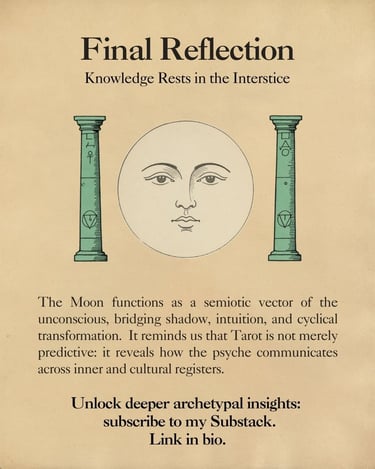
Across both Major and Minor Arcana, lunar imagery in the Rider–Waite–Smith Tarot operates as a visual grammar of partial knowing. The Moon marks moments of transition, ambiguity, and psychic emergence, reminding the reader that understanding unfolds over time and through cycles rather than instant clarity.
Seen this way, tarot does not describe events so much as it maps the conditions under which meaning becomes available. The Moon is not a symbol to be decoded once, but a recurring sign that asks the reader to slow down and attend to process.
7. Tarot and the full spectrum of cognition
This lunar dynamic also points to a broader function of tarot as a cognitive practice. Tarot does not address thinking alone; it engages all four cognitive functions traditionally articulated in depth psychology—thinking, feeling, sensing, and intuiting.
Thinking is activated through structure, symbolism, numerology, and interpretive coherence.
Feeling is engaged through value judgments, emotional resonance, and relational meaning.
Sensing operates via color, posture, spatial arrangement, and embodied response to image.
Intuiting is invoked through pattern recognition, ambiguity, and symbolic association across time.
The Moon, in particular, signals moments when intuition and feeling must be allowed to inform cognition before thinking can responsibly intervene. In this sense, tarot functions less as a tool for answers than as a technology for integrating multiple modes of knowing, resisting the reduction of insight to rational calculation alone.
Seen this way, lunar cards do not depict a failure of decision-making and clarity, but a moment in which the psyche is asked to honor the full complexity of its own cognitive ecology.
CONTACTS
ritarottelbac@dialogictarot.com
SUBSCRIBE TO OUR NEWSLETTER
Rita Rottelbac, phd
Tarot Reader · Visual Artist · Scholar
SITE
LEGAL
RESOURCES
Publications
Your contribution helps sustain the research,
writings, and creative explorations that keep
this project alive.
© 2026 Rita Rottelbac | All rights reserved.
All content is for educational and artistic purposes. Tarot readings are symbolic guidance, not legal or medical advice.
SUPPORT THE PROJECT