
Deck Review: Crystal Keys Tarot by Dina Rosenberg & Amalia Drewes
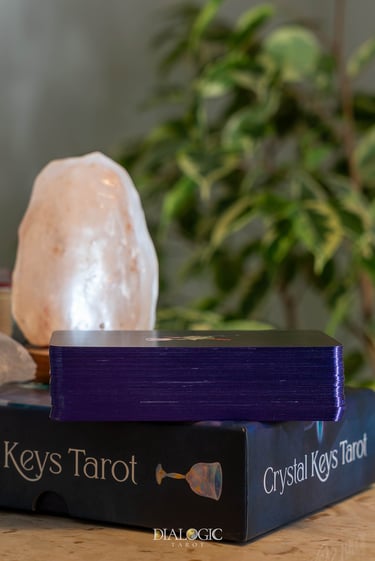
Weiser Books, April 2026 | 78 gilt-edged cards + 176-page full-colour guidebook
REVIEWS
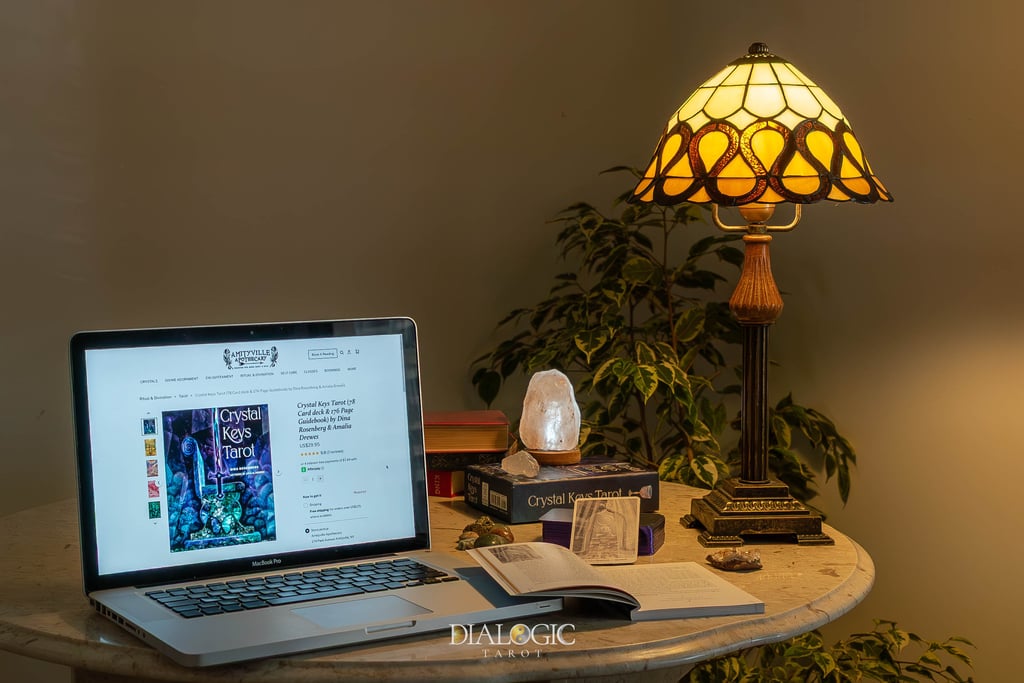

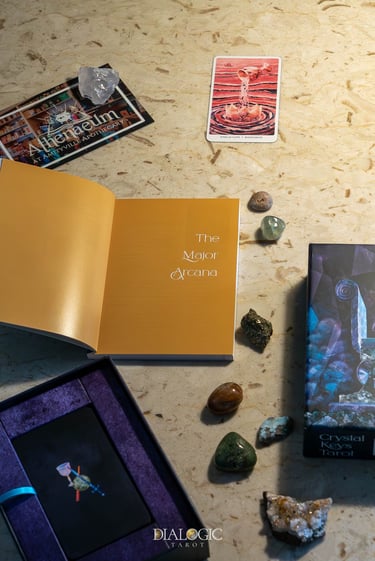
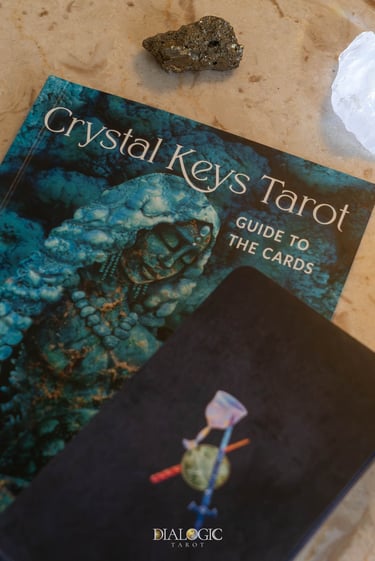
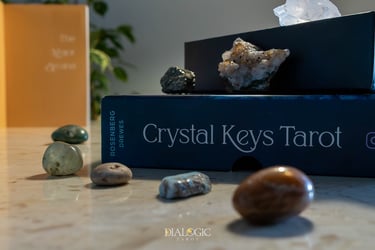
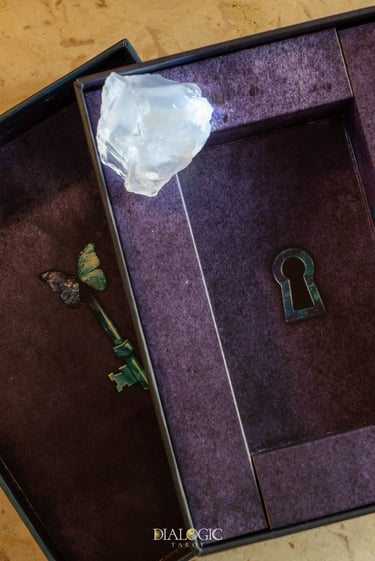
When this deck arrived, I set it on my reading table and just looked at it for a while before I even opened the box. The packaging alone — deep mottled purple and black, spot-gloss accents, the kind of solid two-part construction that signals someone cared about it deeply — told me I was dealing with something considered. That first impression held up. I've now spent a couple of weeks working with these cards, pulling them in readings, bringing them into my teaching, and sitting with the pairings that surprised me. The short version: this is one of the most purposefully constructed decks I've reviewed in a long time. The longer version is what I want to share here, because I think this deck deserves more than enthusiasm.
At its heart, Crystal Keys Tarot does something that sounds simple but is actually quite difficult: it fuses two symbolic systems — tarot and crystal healing — without either one swallowing the other. If you've spent time in the metaphysical world, you know how often that promise goes unfulfilled. Crystal-themed decks can easily become gemstone imagery as decoration, a loose association bolted onto familiar archetypes. The crystals and the tarot sit side-by-side without ever truly speaking to each other.
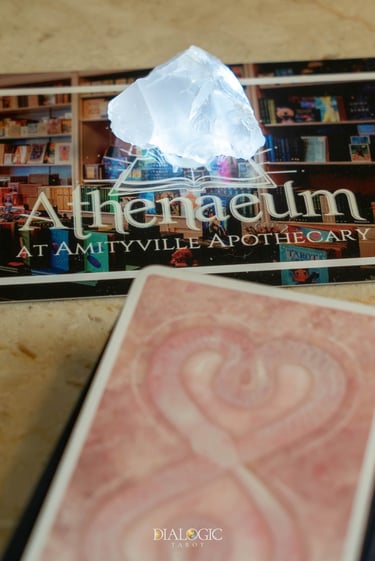
What Dina Rosenberg built here is different, and the reason comes down to how she built it. After decades of tarot practice and deep roots in the crystal healing world — she's the co-owner of Amityville Apothecary on Long Island, a well-regarded metaphysical shop with a substantial community following — Rosenberg spent a full year matching each of the seventy-eight cards to a specific crystal. Not by consulting a correspondence table. By sitting with each archetype and feeling her way to the mineral that genuinely resonated. That's a meaningful distinction, and it shows in the result.
The Concept, and Why It Actually Works
The premise is simple: every one of the seventy-eight RWS-tradition archetypes is paired with a crystal whose energetic and symbolic qualities illuminate something true about that card. What makes this more than a novelty is that the relationship goes both ways. Tarot readers gain a mineralogical lens that deepens their interpretive vocabulary. Crystal practitioners gain seventy-eight new frameworks for working with the stones they already love. As a teacher, I find bidirectional entry points like this genuinely rare and genuinely useful — they meet students where they are rather than demanding a particular starting point.
The deck also functions as what I'd call a corrective to one of tarot's chronic problems: over-abstraction. When you're holding a physical card that looks as though it was carved from rose quartz or volcanic obsidian, the meaning lands in the body differently. It becomes textured and weighted rather than purely conceptual. This is not a small thing. A lot of tarot practitioners get stuck in intellectual interpretation precisely because the cards feel too symbolic, too removed from material reality. The Crystal Keys Tarot solves this problem elegantly — by making the symbolic world feel literally mineral.
The Art: Crystallised, Not Just Decorated
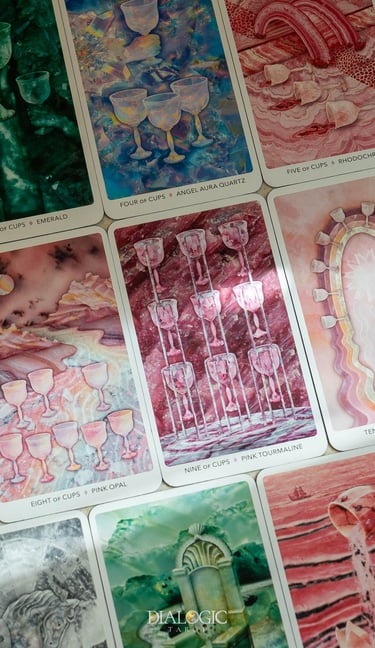
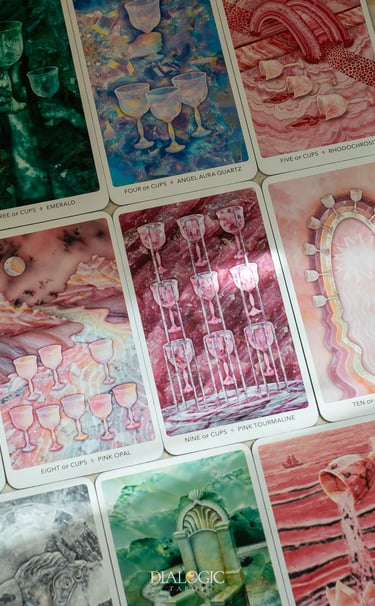
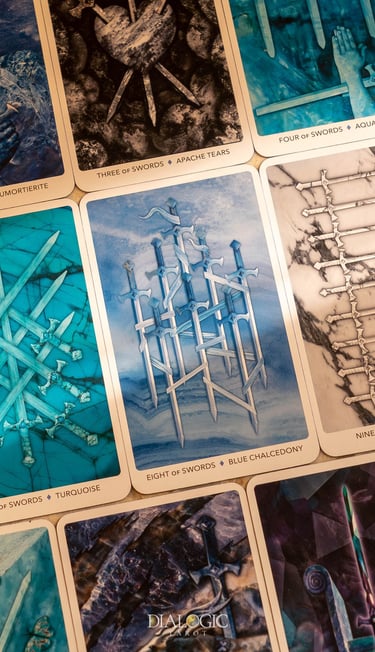
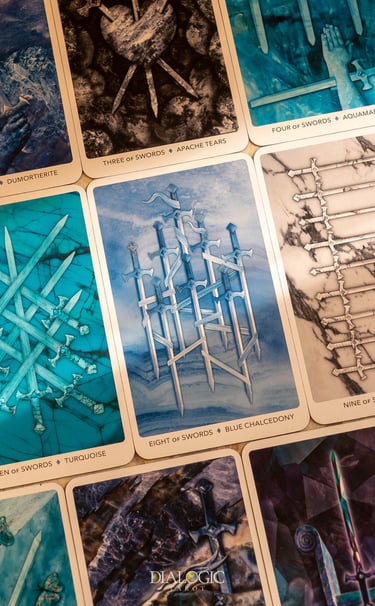
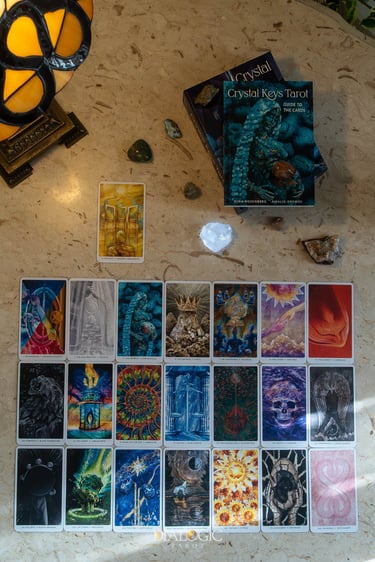
Amalia Drewes, who studied illustration at Parsons School of Design, brings something specific and unusual to this deck. The cards don't simply feature crystals — the figures, landscapes, and symbols appear to be formed from them, as though the archetypes themselves are geological phenomena. Reviewers have reached for the word "carved," and that's apt. These feel like relief sculptures rather than paintings.
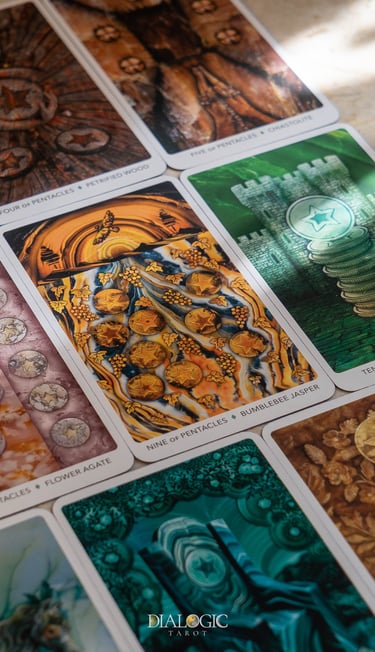
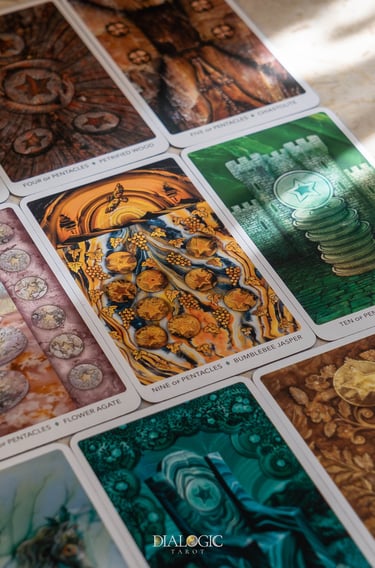
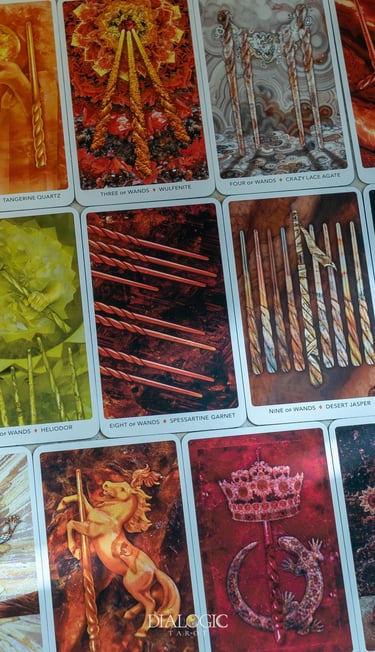
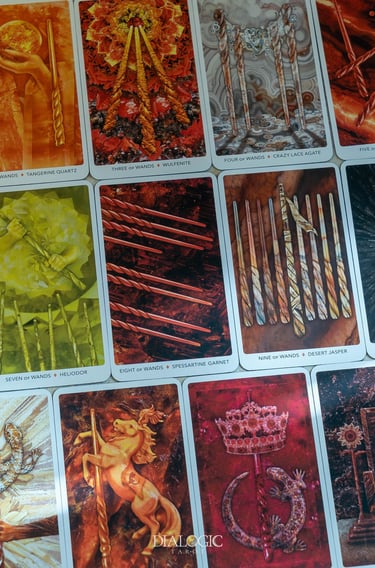
Drewes's background includes grief work — she founded Visual Remedies, a fascinating practice using art and nature therapeutically with people in mourning — and that orientation toward transformation and depth is visible throughout. The imagery reads less like a story being told and more like an energy being held. For readers who work intuitively or somatically, this is a feature rather than a limitation. For those newer to tarot, there is a learning curve; the cards are closer to pip-plus than to fully illustrated scenes, which means the images reward study rather than giving itself up immediately.
The colour choices are doing more work than they might appear to at first. Chromatic decisions track simultaneously with chakra correspondences and elemental suit attributions, creating a layered visual grammar that reinforces meaning without being heavy-handed. This kind of dual coding — where one design choice carries multiple symbolic registers — is the mark of a genuinely well-constructed deck.
On the Crystal Correspondences: Five Pairings Worth Examining
This is the part of the deck I've spent the most time with, and the part where Rosenberg's year of work is most apparent.
The Emperor — Pyrite. Structurally intuitive and satisfying. Pyrite is metallic, ordered in its cubic crystal system, and long associated with material authority and terrestrial power. The Emperor corresponds to exactly that energy: the architecture of structure, governance, and stability. Nothing surprising here, but that's not a criticism — sometimes the obvious pairing is obvious because it's right.
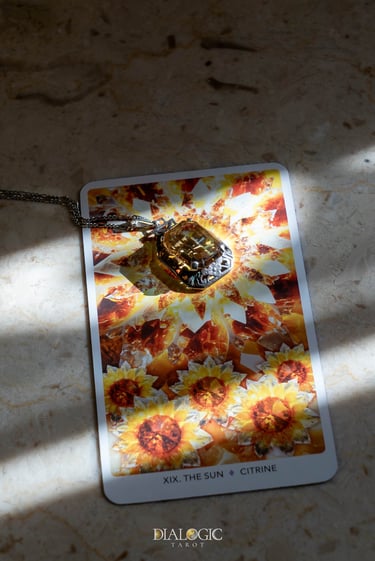
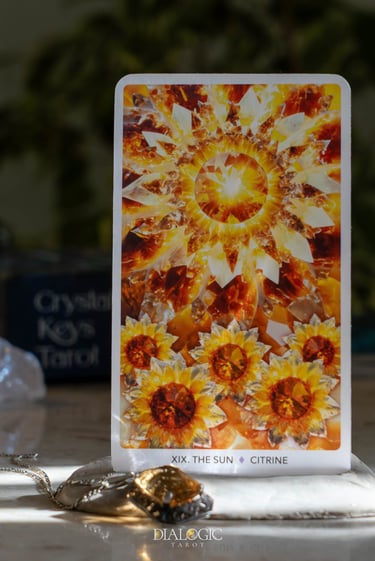
The Sun — Citrine. One of the deck's most harmonious correspondences. Citrine is a sun stone in almost every mineralogical tradition: yellow-gold, associated with vitality, joy, and abundance. It amplifies what the Sun card already contains rather than adding something new, and the result is a card that radiates warmth in both form and meaning. As someone who uses this card to explore the difference between hope and bypassing, this correspondence gives me a grounded, physical anchor for that conversation.
Plus, it is my favourite crystal. I almost always wear it in the form of a beloved vintage 1920s’ necklace I bought from Quinney’s Anique, a jewelry shop in Scotland (see photo below).
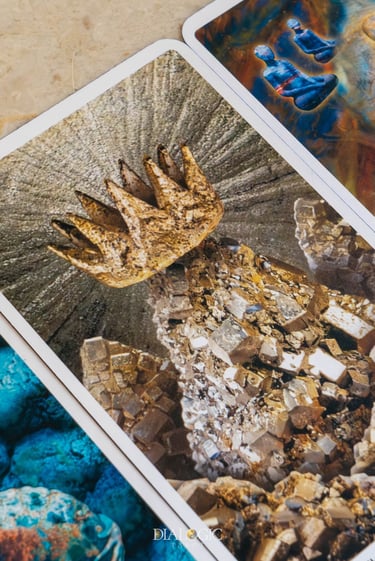
Three of Swords — Apache Tears. This is the pairing I keep returning to. As I have learned, Apache Tears are a variety of obsidian found in the American Southwest, formed when volcanic lava cools rapidly into smooth, rounded nodules — opaque black but translucent when held to the light. Their name comes from a legend tied to the Apache Wars of the nineteenth century: when a group of Apache warriors was killed in battle, the women of the tribe wept so deeply that their tears fell to the earth and hardened into these stones. That origin story is inseparable from the stone's metaphysical identity. Apache Tears are considered among the gentlest and most emotionally intelligent of the obsidian family, specifically associated with grief that is acknowledged, held, and slowly integrated rather than suppressed or bypassed.
Paired with the Three of Swords — the heartbreak card, the card of loss that must be faced — this correspondence does something sophisticated. It doesn't romanticise grief or rush it. It holds the wound while also insisting on grounding, on the body's capacity to bear and eventually transform pain. Where the traditional RWS imagery can feel dramatic (three swords through a heart in a storm), the Apache Tears reframe the card as a stone pressed into your palm that says: you will survive this, and the tears themselves will become something solid. For practitioners dealing with grief in their readings, this is an interpretively generous and emotionally precise correspondence.
Eight of Cups — Pink Opal. Another pairing I find quietly brilliant. The Eight of Cups in the RWS tradition is often read as departure under duress — walking away from what no longer serves, under the light of an indifferent moon. The mood can tip toward bleakness. Pink opal introduces what the card can sometimes forget: softness, emotional self-compassion, the gentleness required for genuine transition rather than mere escape. This is a corrective reading of the archetype that doesn't contradict its core meaning but expands it meaningfully. It's the kind of interpretive move that, as a teacher and reader, I try to model — asking not just what a card is but what it could also be.
The Devil — Black Obsidian. This is the pairing that made me sit with my assumptions for a while, which is exactly what good tarot work is supposed to do. The Devil in the RWS tradition is a card of bondage, of the chains we mistake for necessities, of shadow material and material illusion. The conventional interpretive instinct is to read it darkly — and that instinct isn't wrong. But Rosenberg pairs it with Black Obsidian, a stone whose primary qualities are protection, grounding, and the revealing of truth. Obsidian holds up a mirror. It doesn't trap you in what it shows you — it confronts you with it so you can choose differently.
That reframe matters. The Devil isn't just the card of what has you. It's also the card that shows you what has you — and that the chains, in the traditional RWS image, are loose enough to slip off. Black Obsidian carries that same dual energy: it goes to the dark places, but it goes there with a torch. For readers who find The Devil card tends to either frighten querents or get dismissed with too much reassurance, this correspondence offers a third way — clear-eyed, grounded, and ultimately oriented toward liberation rather than condemnation.
The Tower — Moldavite. This is the pairing most likely to divide opinion, and the more I work with it, the more I think Rosenberg got it exactly right. Moldavite is a tektite — a rare form of natural glass formed not by geological processes but by a meteorite impact approximately 14.7 million years ago in what is now the Czech Republic. Molten material was ejected into the atmosphere on impact, cooled as it fell, and landed across the Bohemian plateau. It is, in the most literal sense, a stone of catastrophic external force. Known in crystal practice as the "stone of transformation" and often described as having the most intense energetic profile of any commonly worked stone, moldavite is associated with sudden, irreversible change — the kind that arrives from outside your plans and leaves you permanently altered.
Paired with The Tower, this is not a comfortable correspondence. It refuses to minimise what the card actually means. But it also reframes the catastrophe: not as punishment or failure, but as something initiated from beyond the personal — cosmic rather than merely unlucky. If you've ever tried to console someone going through a Tower moment by reminding them that something new is being cleared for, moldavite gives you a geological argument for that claim. The destruction is the arrival of something extra-terrestrial. That's a meaningful interpretive frame, not just a metaphor.
A Lineage Worth Knowing: Liber 777 and Crystals in Ceremonial Magic
Something I haven't seen mentioned in other reviews of this deck — and that I think serious practitioners deserve to know — is that tarot-crystal correspondences also have a legitimate esoteric lineage. There is a precedent, and understanding it makes what Rosenberg has done with the Crystal Keys Tarot even more interesting.
The Hermetic Order of the Golden Dawn, working in the late nineteenth century, built one of the most ambitious symbolic correspondence systems in Western esotericism. Their work was later codified and published by Aleister Crowley in Liber 777 (1909), a dense recollection of tables mapping Hebrew letters, Kabbalistic paths on the Tree of Life, deities, plants, perfumes, magical weapons and precious stones into a single interlocking architecture. There is a "Precious Stones" column in Liber 777. The Major Arcana do have gemstone correspondences. But they are not organised by tarot card. The link is always the Tree of Life. To find the stone for The Devil, you need to know that The Devil corresponds to the Hebrew letter Ayin, which traces Path 26 on the Tree of Life, which is associated with Black Diamond. The card is the last stop, not the first. The whole system presupposes years of initiatory study just to navigate it. Which means that in practice, the Golden Dawn's crystal-tarot correspondences were hardly accessible as a working tool. They were a reward for initiates, legible only once you already understood the Kabbalistic architecture behind them.
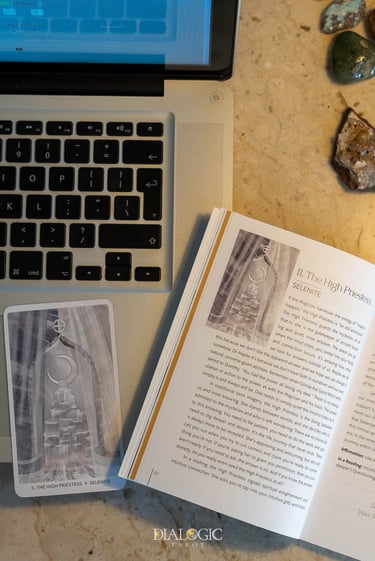
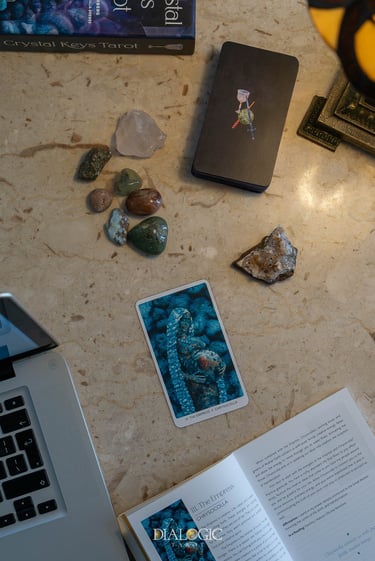
What Rosenberg has done is effectively democratise and personalise a system that was previously locked inside a much more demanding framework — replacing the Tree of Life as the organising structure with something far more immediate: the felt sense of a reader who has spent decades with both the cards and the stones. The philosophical divergences between the two systems are also telling. Let’s take the Devil card as an example. The Golden Dawn assigns Black Diamond to The Devil — a hard, faceted stone associated with amplification and the unflinching clarity of carbon under pressure. Rosenberg assigns Black Obsidian — a volcanic mirror, softer in edge, oriented toward revelation and grounding. These are genuinely different premises about what The Devil card is asking of you. The Black Diamond says: look at this with absolute precision. The Black Obsidian says: let the darkness show you what you've been avoiding. Neither is wrong. But they illuminate different rooms in the same house, and the difference tells you something about the gap between a ceremonial magical framework and a contemporary psychological healing-oriented one. This isn't the place to adjudicate between them; a reader who knows both traditions is richer for it. But it is worth naming that Crystal Keys Tarot sits within a lineage, and that Rosenberg's departure from that lineage is as meaningful as her debt to it.
How to Use the Deck
Tarot's power has always rested partly on its multivalence — the same card can mean radically different things in different contexts, for different readers, in different spreads. When you anchor each card firmly to a single crystal correspondence, you gain interpretive clarity but risk sacrificing that openness. Less experienced readers in particular may find themselves defaulting to the crystal meaning when the card is asking for something more situationally specific. This isn't a flaw of the deck — any structured system carries this tension — but it's worth naming. My suggestion for working with this deck is to treat the crystal correspondences as an authoritative voice in the conversation. From this perspective, the cards’ mineral meanings can work as an additional lens that deepens the comprehension of the tarot archetypes. I'd also note that the deck assumes a degree of engagement with crystal energetics.
Who Is This Deck For?
It's for practitioners who already work with crystals and want a tarot deck that meets them in that language. It's for tarot readers who feel their interpretations have become overly abstract and want to be pulled back into the physical and the tactile. It's for anyone who has ever found the Three of Swords too cold and wanted a heartbreak card that also held them. And it's a genuinely excellent learning deck: the bidirectional entry point means you can come from either direction and find a new door opening. It is not the deck I'd give to an absolute beginner as their first tool, but as a second deck, or as a companion to study, it's one of the most purposefully constructed releases I've reviewed this year.
A Final Note
What Rosenberg and Drewes have built here is something the tarot world cannot get enough of: a deck with a genuine argument, an authentic soul, and a research process that is both rigorous and deeply personal. The argument is that archetypes are not only psychological constructs but also material phenomena — that the meanings we carry through life have weight, texture, geological age. Whether or not you hold that cosmologically, it is a productive interpretive premise and a due chapter in any serious metaphysician's course of study. The Crystal Keys Tarot changes how you sit with the cards. That, ultimately, is what a good deck is supposed to do.
CONTACTS
ritarottelbac@dialogictarot.com
SUBSCRIBE TO OUR NEWSLETTER
Rita Rottelbac, phd
Tarot Reader · Visual Artist · Scholar
SITE
LEGAL
RESOURCES
Publications
Your contribution helps sustain the research,
writings, and creative explorations that keep
this project alive.
© 2026 Rita Rottelbac | All rights reserved.
All content is for educational and artistic purposes. Tarot readings are symbolic guidance, not legal or medical advice.
SUPPORT THE PROJECT